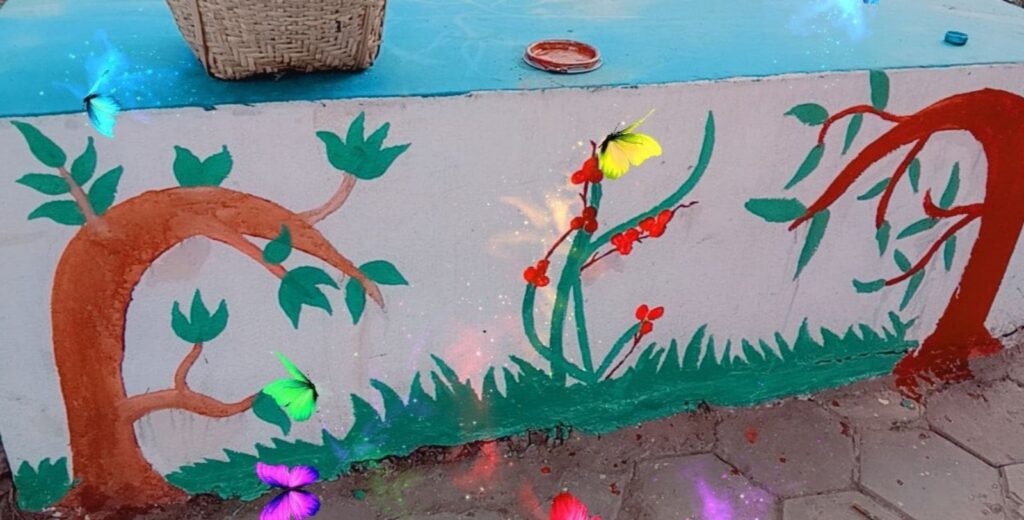
मसँग काठमाडौंमा ५ रोपनी जग्गा भए…..

सानो सानो टुक्रा गरेर, आनाको करोड करोडमा बेच्दिनथें, खुला मैदान बनाएर घण्टाको ५० र १०० पार्किङ शुल्क लिएर राख्दिनथें, कसैलाई सर्लक्क लिजमा दिएर, दस वर्षको भाडा उठाउँदिनथें । त्यसो भए तपाईंहरूले सोचिरहनु भएको होला, के गर्थे होला भनेर? आफैँ घर बनाएर बस्थे, ठूलो कम्पाउन्डले घेरेर? अहँ, त्यो पनि होइन।

म त ठूलो चौर बनाउँथें – नेपाली दुबोको, त्यसमा साना साना बगैँचा पनि थप्थे, रंगीबिरंगी – आफ्नै शहरको प्रजातिको बोटहरूका। अनि उफ्रने, खेल्ने, शान्तमा चराहरूको आवाज सुन्ने, भारी बिसाउने, एक छिन सुस्ताउने र प्रकृति र समाजसँग अझ नजिक भई नियाल्ने वातावरण बनाउँथें। म, एउटा आर्किटेक्ट, त्यसमा मेरो मास्टर्सको पढाइ चाहिँ ल्यान्डस्केप आर्किटेक्चर। त्यसमा पनि मेरो फोकस भन्नुपर्दा काठमाडौं र काठमाडौंजस्तै अरू शहरका लागि खुला ठाउँ व्यवस्थापनको लागि फ्रेमवर्क बनाउने। पढाइ नै त्यसै सम्बन्धी गर्न मन लाग्यो, दिनदिनै आफ्नो शहरको रूप कुरूप भैरहेको देख्दा। सानो छँदा खेलेका, दौडेका, कति धेरै सम्झनाहरू बनाएका ठाउँहरूमा आजभोलि बच्चाहरू खेल्दैनन्। त्यहाँ त केवल जग्गा सम्याउनका लागि डोजर चल्छन्, ढलान गर्नका लागि क्रसरहरू चल्छन्, एक इन्च जग्गा एता उता होला भनेर दाजुभाइहरूका तिखा तिखा शब्दहरू चल्छन्।

यस्तो पौउको भौउमा बिक्ने जग्गामा कसले खुला ठाउँ राख्ला र! अनि मैले यस्तै कुरा गर्दा सबै जनाले मलाई पागल भन्छन्। र मैले म भएको भए त यस्तै गर्थें भने भने, “तेरो छैन र त भन्छस् नि” भन्छन्। अचम्मको कुरा त के छ भने, यो तितो हुँदै गैरहेको समाज, यो एक अर्काप्रति नकारात्मक सोच, सधैं हुने इरिटेसन, यो सबै नै हामी कहाँ शहरी हरियाली नहुनु र दिनदिनै बढ्दो प्रदूषणको नतिजा हुन सक्छ। यही ठाउँमा त अनुसन्धान गरिएको छैन, तर विश्वका शहरहरूमा भएको अनुसन्धानमा यस्तो कुरा प्रमाणित भैसकेको छ।

बच्चाहरू स्वतन्त्रसँग आफ्नो घर वरिपरि आफ्नो उमेरको हिसाबले कति परसम्म जाने, यस्ता कुराहरू पनि विश्वमा अनुसन्धान भैसकेका छन्। आजकल त पन्ध्र मिनेटको शहर भनेर निकै चर्चामा पनि आएको छ। यो भनेको चाहिँ सबै दिनदिनैलाई चाहिने आवश्यक कामकाजका ठाउँहरू मात्र १५ मिनेटको दुरीमा। विश्वका शहरहरू निकै ठूला छन्, त्यहाँ हिँडेर अथवा साइकलमा धेरै टाढासम्म पुग्न सकिन्न। पहिला शहरको योजना बनाउँदा, धेरै नै ठूला सडक, गाडीमा मात्र ध्यान दिएको पाइन्छ। यस्ता ठाउँहरूमा आजकल यस्तो पन्ध्र मिनेटका शहर र बस्तीका कल्पना गर्न थालिएका छन्। तर हाम्रो काठमाडौं शहर, जुन पहिले पैदलमैत्री थियो, अहिले बाटोमा हिँड्नै नसकिने भएको छ। यति सानो, चिटिक्क परेर मिलेको शहर, मानिस र साना साना बच्चाहरूलाई मनपर्ने खालका बाटाघाटा, सानो सानो चोक र गल्लीहरू, जहाँ मानिसका भावनाहरू साटिन्छन्, कल्पनाहरू फुर्छन् र जहाँ साना साना नानीबाबु खेल्दै, लड्दै, पढ्दै रमाउँदै र धेरै कुरा सिक्दै डुल्न सक्छन्, यस्तो शहरलाई मासेर कहिले सम्म हामी पश्चिममा फेल भैसकेको अवधारणामा हाम्रो शहरी योजना बनाउने? अब पनि नसिक्ने?

ठूला ठूला अनुसन्धान संस्थाहरूले करोडौं खर्च गरेर अध्ययन गरिरहेका शहरका अवधारणा त हामीकहाँ अहिले यसै छ। त्यसलाई मासेर हामीचाहिँ उनीहरूले फालिसकेको मुकुन्डो लगाएर बस्ने? हाम्रो शहर विकासका योजना बनाउने, मन्त्रालय, स्थानीय निकाय र सबैभन्दा धेरै प्रभाव पार्न सक्ने हाम्रो शहरका प्रतिनिधि मेयरहरूलाई मेरो प्रश्न र सुझाव पनि – अन्तर्राष्ट्रिय स्तरको अनुसन्धान र अध्ययन गरौं, समाधान र विकल्पचाहिँ हाम्रो स्थानीय सन्दर्भसँग मिल्ने बनाऔं। मात्र यत्ति गरिदिए पुग्छ।

नीति ढाँचाहरू त बन्दै गर्छन्, र त्यसलाई अपनाउँदै जाने हो। तर सर्वप्रथम के गरेर शहर राम्रो बनाउने भन्दा पनि के चाहिँ गर्दै नगर्नेमा हामी ध्यान दिऔं। यसमा तपाईंहरूलाई थुप्रै किसिमका विज्ञहरूको आवश्यकता पर्छ। एक्टिभिजमले हामीलाई चेतना त दिन्छ, तर दिगो विकासका लागि विज्ञहरूको सल्लाहबाट आफ्नो कार्यहरूलाई सकारात्मक र सफल बनाउनुहोस्। सही विज्ञहरूको पहिचान गर्नुहोस्। र स्थानीय बासिन्दाहरूको कुरा सुन्न र समावेश गर्न नछुटाउनुहोस्। र सबैभन्दा महत्त्वपूर्ण, सबैभन्दा कमजोर र सीमांतकृत जनसंख्याका लागि योजना बनाउनुहोस्। बलियाबाङ्गाले त आफ्नो जोहो गरिहाल्छन्, ती निर्बलका लागि शहर बनाउनुहोस्, समावेशी हुनुहोस्। वास्तवमा उनीहरु कमजोर होइनन्, हाम्रो शहर उनीहरुको लागि असक्षम हो – सफल शहरमा सबैले आफ्नो स्थान पाउनुपर्छ।

शहरमा खुला ठाउँ र हरियालीलाई प्राथमिकता दिनुहोस्। यस्ता हरियालीका ठाउँहरूमा हाम्रा नेपाली बोटबिरुवालाई प्राथमिकता दिनुहोस्। र यस्ता ठाउँहरू बालमैत्री, बच्चाहरूसँगै मिलेर योजना बनाउनुहोस्। यस्ता खुला ठाउँहरू राम्रोसँग योजना गरेर बनाउन सकियो भने यसले हाम्रो शहरको सामाजिक र सांस्कृतिक लाभ, यहाँ बस्नेहरूको शारीरिक र मानसिक स्वास्थ्य लाभ, यहाँको वातावरणमा सुधार हुने प्रभाव साथै यहाँको आर्थिक लाभमा समेत टेवा पुर्‍याउँछ। सुनेको छु, हाम्रो शहरमा थुप्रै सार्वजनिक खुला ठाउँहरू मासिएका, मिचिएका छन्। कति रोपनी जग्गा त पत्ता पनि लागिसक्यो रे। यस्ता जग्गाहरूलाई फेरि पहिचान गरी यस्ता ठाउँहरूमा हरियाली प्रवर्द्धनका कामहरू गरौं। फेरि हाम्रा बालबालिका उफ्रिने, दौडिने, लड्ने र लडेर फेरि उठ्ने ठाउँहरू बनाऔं। यी साँचै नै आधारभूत आवश्यकताहरू हुन्। र यो गर्नुका फाइदा पनि छन् शहरी विकासका लागि। यसरी हुर्केका बालबालिकामा आफ्नो ठाउँसँगको आत्मीयताको विकास हुनेछ र आफ्नो ठाउँको हेरचाह गर्ने जिम्मेवारीको चेतना पनि। उनीहरू सधैं शहरका सबैका लागि वातावरण राम्रो बनाउन काम गर्नेछन्।
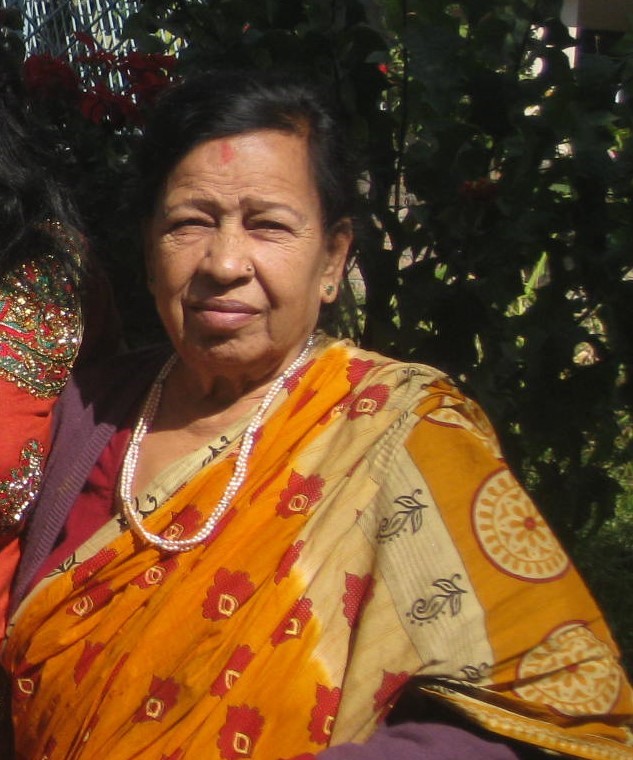
We need to rethink our notion of ‘Who plans and shapes our cities?’

One can simply say ‘planners, designers, architects are responsible to make a city liveable’, but there is an overarching theory to it, – ‘who has the finances, who sponsors the projects, who have vested interest and power’ are the ones who build the cities. Most of the projects being funded by the government take a big political influence.

Being an architect myself and with expertise in open space planning, I have bagged many projects through multiple links and experiences as an architect. But when it comes to landscape planning and public space designs, my expertise is not valued as much as the local representative’s interests. The private projects related to construction are more resource-dominated. An architect’s knowledge is dominated hugely by vested interests, majorly political, financial as well as lack of respect for the profession, the cities are massively impacted. Especially when it comes to open space planning, we have to take a different approach altogether. There is no perfect design but we should let the space develop as the people start using it, we allow freedom and expression. We should not tap into our expertise but we should tap into humanity as Amanda Burden, an American urban planner said. This does not mean we do not do anything, we actually have to create the canvas where the public can do their art with their movement, we create a theatre where the public will perform their acts, we create a universe where public create their own ecosystem along with other species. There is no institution here in Nepal, which prepares such experts and the ones who have studied abroad and come back to give their knowledge and learning to their community are not welcomed. This makes experts like us sad and frustrated because we can see that what is happening in the city is not right and it will have a long-term impact to all of us but we are not in the position to change it and nobody is ready to listen.

The discussion put forth is in itself controversial because in Asian cities, particularly in Kathmandu, I have seen the professionals who are supposed to shape and plan the cities – planners, architects, construction managers and conservationists not being able to use their expertise but more playing the roles of activists when the authorities are not able to make good plans and proper management policies for the city. These government authorities do not consult and hire the experts but they rely on their resources who come to work in government jobs through a common IQ-based entry examination. The module of exams is outdated and those who pass these examinations come through tough competition of not argumentation and creativity but more of the banking system of education. I believe these government officers should play the role of managers and let external experts do the technical jobs. But as soon as they are in a position to make decisions, they want to implement their own ideas without much research and planning. Even when they hire experts, they try to impose their own understanding and solutions. Most of the time, its not even a lack of expertise, it’s the lack of a good mindset. This lag in the system is making the city pay a huge price when it comes to sustainable development and regenerative green spaces. I have worked both as an architect as well as a community planner. I have experienced there is no democratic decision-making and planning approach when it comes to planning open spaces. People, especially children lose connection to their environment, both natural and social, and are deprived of their basic needs. We need to expose them to their environment so that they explore and reach their potential with social, physical, and psychological development and later become responsible citizens. When this happens they understand the need of the city and use their skills and knowledge to make it better, that too, with collaborative approach.

So how do we pierce through the bureaucrats as well as elected members in the local community? After I completed my master’s I came back to Nepal to share my knowledge and implement it through various agencies. Initially, I tried to go to the local areas with solutions and it did not work. As an expert, I could not convince them with my strategies. Then I worked out a way to work together with them but the adults who are in the position to implement the plans were not ready to accept my ideas, they were not even ready to work together. Then I took the approach of working with children. This approach has been widely used in many cities of the world now. The contemporary urban planners and researchers in children spaces and development both believe that children can act as catalyst for urban innovation. Their views are more diverse and they can bring solutions to their communities if they can have meaningful participation. Hence, I also used it contextually in different neighbourhoods of Kathmandu, successfully.

Though this has been realised in urban planning community globally, how to do this was not the issue raised by many contemporary researchers. I, therefore, moved towards the solutions, not by proposing the solution but by taking the actual steps which could lead to the solutions involving the main stakeholders.

As a researcher hence I tried to find a balance between research and action. I went into the community, especially to the vulnerable groups, in this context the urban middle-class children and worked with them, co-researched with them to find out the actual situation of community spaces and how they are shaped and how the issues can be solved. I conducted participatory action research with the children in different communities in Kathmandu to find out the situation of their environment through their lenses and also to propose a solution for the same. Participatory action research is an approach which believes in critical pedagogy which means giving voice to the ones who are oppressed, which is in line with the concept of Paulo Freire who believed that education must aid in developing critical consciousness and the learners or the participants must act to liberate themselves and the society also from the injustice, their engagement is crucial for this.

I believe that this type of grassroots intervention can actually bring forth solutions to the existing problems, as people who are actually living in such situations will be able to identify the genuine problem and in turn, propose solutions for the same, and in the process, empower themselves. If we continue such efforts, we can really bring about a change in the community, then in the city and in the country as a whole. But the process should be continuous as well as there should be a genuine concern for the well-being of the community through planned neighbourhoods and action-oriented interventions. I say this always and each time, that the people are not supposed to be fed, they are to be taught to grow and prepare their own meals.

As the city is a dynamic built, anyone who wants a city to thrive, must study it, make plans for it and then act upon it – not once but in a continuous cycle. There must be support from the government and local bodies for these types of interventions and research.

Coming back to the topic of this article ‘who plans and shapes the cities?’

I would like to add my favourite quote from a very famous urbanist/author/activist whose theories and observations are the holy book for architects and urban planners –

‘Cities have the capability of providing something for everybody, only because, and only when, they are created by everybody.’ – Jane Jacobs

Are we ready as experts, as authorities, as people in the position to play our roles to give the citizens especially children, their rights to a healthy and thriving city, in the process also make them responsible? or do we want to create more constraints and thus make our society ever more ill? Do we want to make a win-win in the battle or do we want to lose our society?

आज एउटा कथा सुनाउछु

धेरै पढेर बिग्रिएको म

स्वतन्त्र भएर मात्तिएको म

सोमत मान सम्मन बिर्सिएर

लाज सरम पचाएको म

संस्कार पाएकै हो मैले त राम्रो

दुख नदिनु अरुलाई

अरु माथिको अन्याय पनि हेरेर नबस्नु

तर मैले देखेको अन्याय किन देख्दैनन अरुले

आँखा अलि कम्जोर कि मन नै कठोर यिनिहरुको

नैतिक दृष्टान्त त मेरो फेवरेट कविता

जिन्दगी को जुन सुकै परिस्थितिमा  पनि

दुई लाइन त्यो कविता पढे

जस्टिफाइ हुन्छ सबै कुरा

तेही पढेर झुक्न कोशिश गरे

टाउको मेरो सारै थाडो

बाझ्दै हिँड्छु म एक्लै

अन्याय सहन निक्कै गाह्रो

धेरै बुझेर नकचराएको म

धेरै नै सोचेर भाँडिएको म

धेरै सम्झेर आत्तिएको म

साचै नै हो त

धेरै पढेर बिग्रिएको म ?

रेमिटेन्सको तितो सत्य

पुरा हुन नसकेका तिम्रा ती अधुरा सपनाहरु

वेदनामा डुबेका तिम्रा ती रित्ता आकांक्षाहरु

पिडामा छट्‌पट्‌याएका ती तिम्रा मनोभावहरु

ऐया आथा कति गर्यौ होला ती खोक्रा बिश्वास मेटिदा खेरि

मर्न त मानिस एक दिन मर्छ

हरेक दिन एउटा नेपाली भित्र भित्रै मर्छ

यी तस्विर हरु हेर्दा कसको मुटु नकाप्ला र

अहो लाचार ती हाम्रा पाखुराहरु

श्रम गरूम भन्दा खेत बेच भन्छन्

दुख आफ्नो देश मै गरु भन्दा कमिसन ले भन्छन्

ल त पैसा नै बोल्छ यो संसार मा भनी बिदेशिदा

बोल्न सधै को लागि नसक्ने गरी फिर्ता हुन्छन्

बोल्न सधै नै नसक्ने गरी फिर्ता हुन्छन्

Heart that always loved – Maami

I will not stop dreaming, I promise to your sparkling eyes.
I will not be afraid to try, I promise to your witty smile.
I will fight and fight, I promise to you and your life.
I will always smile and let it go, I promise to your last good bye.

Words are not enough.
Moments were never enough.
Wanted to stay with you a little longer.
Wanted to hear your voice a bit more.

You were that grandmother I could get upset with.
You were that grandmother who could bring my smile back.
You truly were my mother’s mother.
With the same hearts beating together.

‘Maami, I love you’, I used to say.
You said ‘it was for lovers’ and you were shy.
Then you would repeat ‘I love you too’.
After I explained we are lovers too and why.

Relationships are not always smiles.
But togetherness is what remains.
Your tales are never ending.
Your heart a pure gold.

As you truly rest in peace.
I promise to keep you alive.
In my memories.
And my endless tales.

Acid on her face

Mehendi on her hand
Acid on her face
Her destiny will not change
It’s a cry of faith

Faith she had in her strength
That struggles to find existence
Giving up she never learnt
The cruelty will soon behead

Laughters and therapies
Intense care and support
She will rise up again
With the strength to defeat the demon

The demon, it lies in you
It lies in me
We will defeat it together
The battle is against us

She is not a girl
But truth of a disgusting society
Shameless and strengthless as we are
The traitor finds its way

The colours of her mehendi will go away
But the scars will remain
The coward devil doesn’t know
Her inner strength has deepen even more

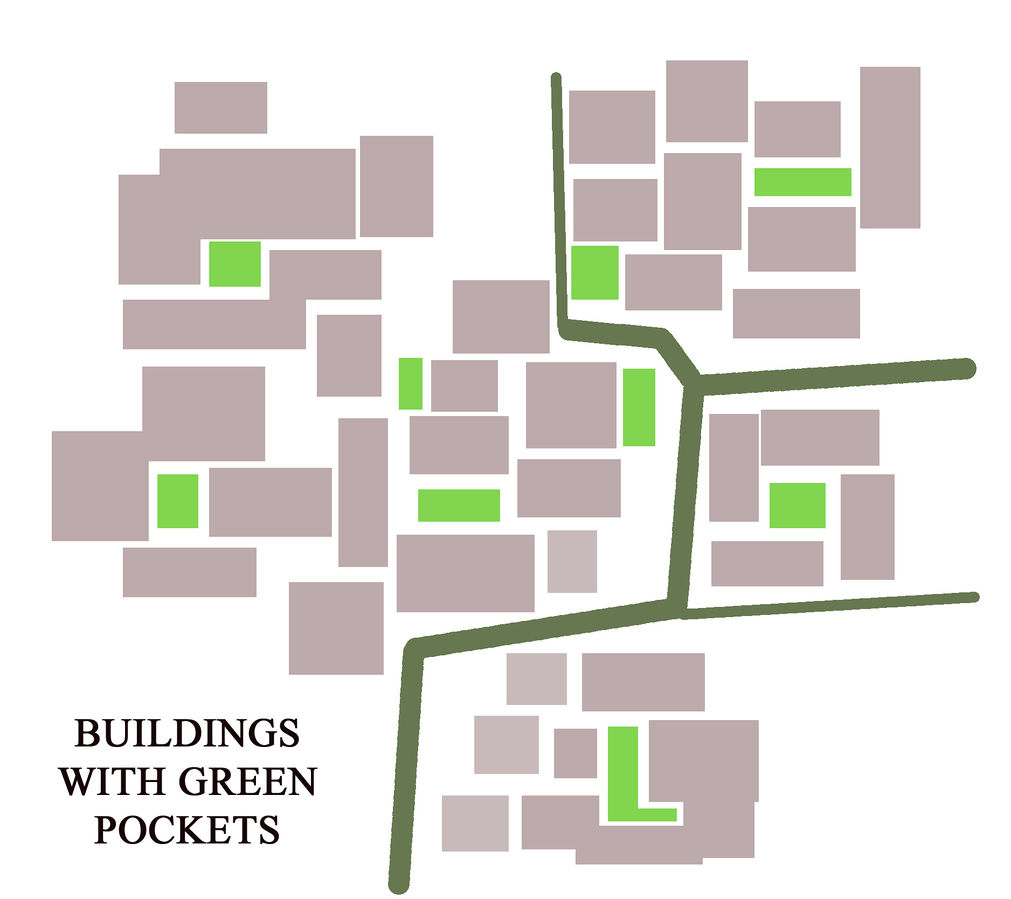
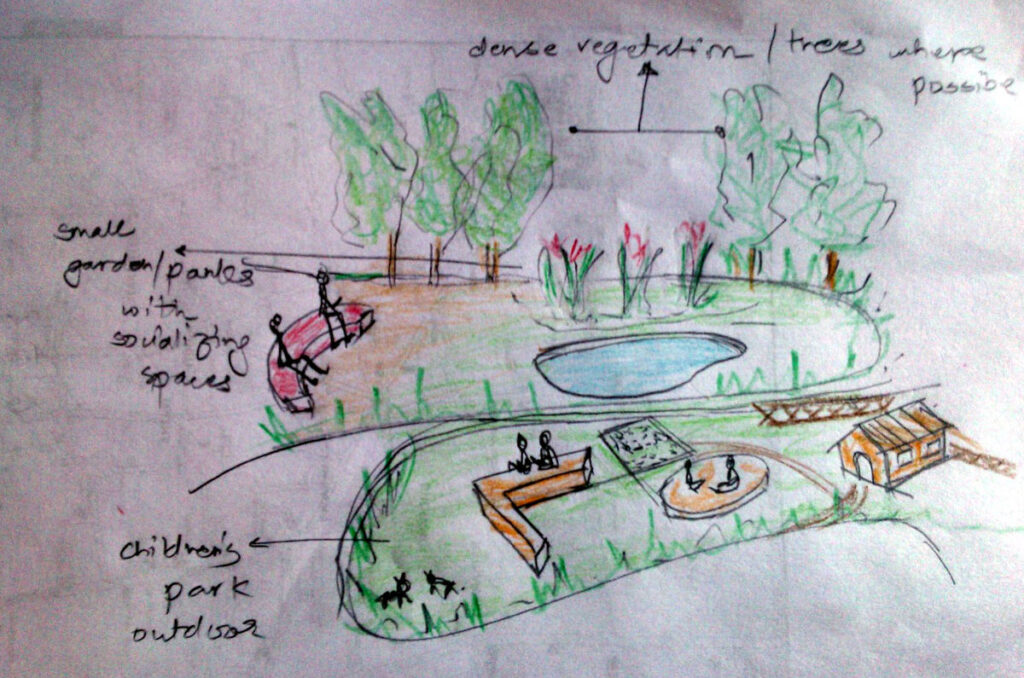
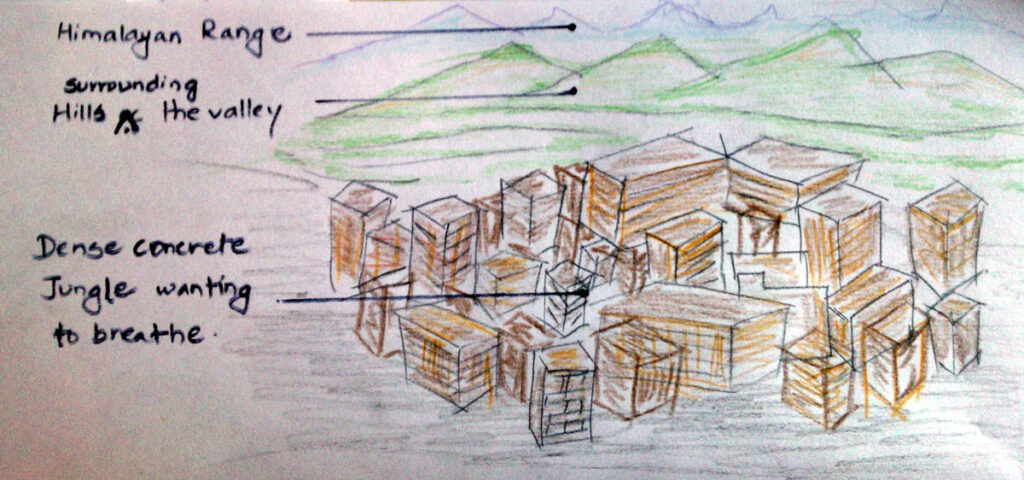
Green Pockets might provide some relief to the concrete jungle

This is a link to my very initial project of providing better green/open spaces in Kathmandu Valley when I had just started my Master’s degree in Landscape Architecture. After almost 5 years, how strongly I still believe in the vision I had back then. Surely, my horizon has expanded and I am able to look at it through many perspectives and dimensions. Hence, making me more focused on how to achieve my goal. Do click in the link below to find out more.

https://fluswikien.hfwu.de/index.php?title=Planting_Design_2013_Working_Group_14_-_Case_Study_D

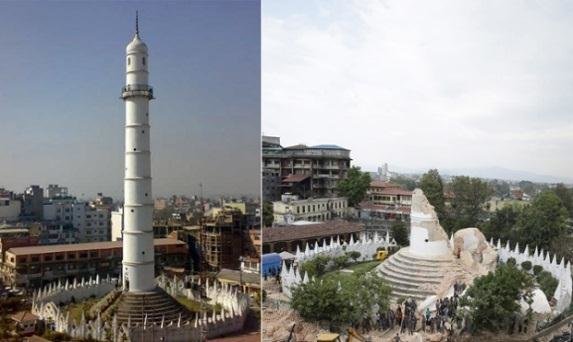
A monument that deserves respect and a memorial that could unite – Dharahara

Dharhara Tower at Kathmandu, Nepal before and after the earthquake of April 25, 2015 (Source: http://www.theguardian.com)

Dharahara Tower: also known as Bhimsen Tower. This tower was built in 1832 by then Prime Minister Bhimsen Thapa of Nepal under the orders of the Queen. In 1934 earthquake, this tower almost collapsed and it was renovated by then prime minster Juddha Shamsher. It was opened for public in 2005 for viewing from the eighth floor holding a circular balcony which provided a panoramic view of the whole Kathmandu Valley. (Dharahara, n.d.) Sadly, it fell down completely, along it many people also fell and lost their lives.

It has not been there for 4 years. It seems like it will not stand any time soon. Will it re-acquire its dignity if it stands tall again through the rubbles? Will the people who lost their lives in the disaster be remembered? Will the new generation be able to feel the pain and grief that was risen by its fall? All these questions will be answered differently with different perspectives. Here is my perspective on how to rebuild or how to make a memorial that will last for generations to come and to connect in a way that will slowly heal the wound and make each one of us stronger from inside.

Dharahara complex as a whole could be defined as a city’s public space. Hence while redesigning, it could be taken as an innovative public open space which speaks history, at the same time, a lot of emotions attached after it collapsed in 2015 earthquake.

The best remembrance in this city core area could be a museum or a memorial to remind everybody of the disaster that took place on 25th April, 2015. This is very important because people tend to forget the past and remind the new generations about the events. If this is presented as a remembrance to the city and devoted towards the loss of heritage and loss of lives of the people, the future generation will also witness it and be more alert and prepared.

The tower shall be constructed again, not above the ground, but underground. The damaged structure remains as it is, and its story will be told in the underground memorial.

The museum could showcase pictures, photographs of the people and also the places that were most affected, how people were sheltering after the earthquake. Each corner will tell different stories of the people who struggled and survived, how bonding among the neighbours increased, how people were there to help each other and many more events that took place during that time that could connect and inspire. Different artists could come together and express their creative perceptions. This museum would be as a shadow on the ground floor to the monument and it would go underground through which people walk and only after the full story is told they reach the collapsed monument to finally feel the grief. The monument was white in colour and the shadow could be with darker (black) effect, lights would pass through different angles for the displays to be seen.

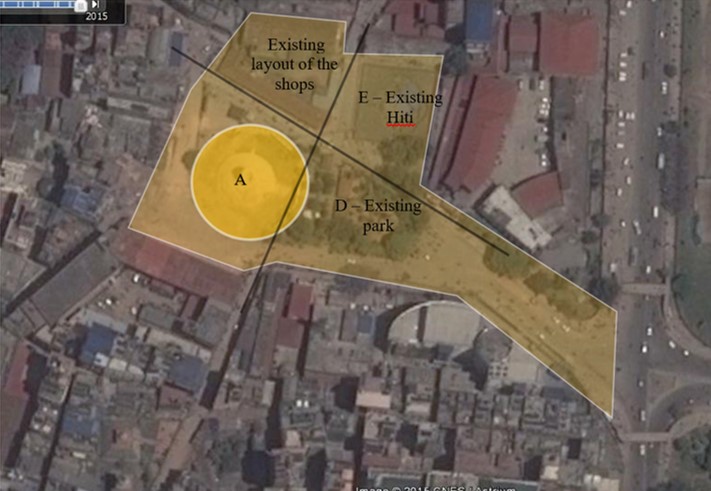
At the outside, surrounding areas will have open spaces as an urban park where people can relax and interact with each other. It already has a sunken water feature (Hiti) which can be revitalised. The existing shopping block could be converted from enclosed space to open space interacting with the Hiti and the Monument zone. With minimal intervention, this outer space could engage the passersby and leave a feeling of grief and affinity.

Site condition of Dharahara complex after the earthquake in 2015 (Photo source - Google earth)
Site condition of Dharahara complex after the earthquake in 2015 (Photo source – Google earth)
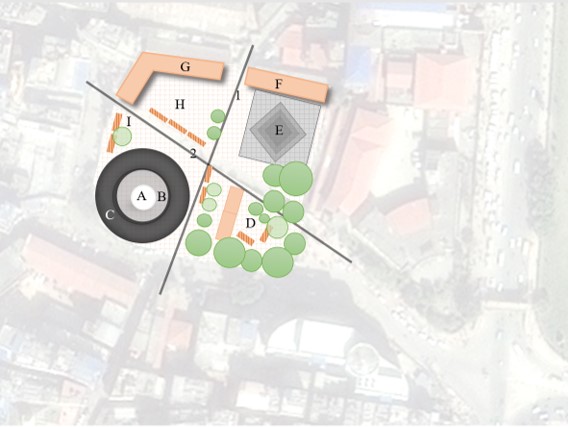
Proposed Design of Dharahara complex as a whole
Proposed Design of Dharahara complex as a whole.

Legend:

  • A – The collapsed monument as it is;
  • B – The transition between the monument and museum;
  • C – The underground museum/memorial which symbolises as shadow of the monument;
  • D – Existing park area;
  • E – Existing historic Sunken water body (Hiti);
  • F – Shaded rest area (Pati);
  • G – New layout of the existing street shops (to make the spaces more connected and vibrant);
  • H – The Open space achieved after the alteration;
  • I – Seating area outside the museum; and
  • 1 and 2 are the axes that are created by the existing routes and entrance.

Proposed design derived from :
Dhungel, A. (2015). IDENTITY, LIVEABILITY and RESILIENCE: Open Space Categorisation and Management in Kathmandu Valley. Master’s Thesis: Weihenstephan-Triesdorf University of Applied Sciences, Freising, Germany.

Let Play be Public

I have seen in Kathmandu barren pieces of lands. I have seen them being empty most of the times. Kathmandu valley has six seasons, it is the most dynamic place in terms of weather. Summer is not too hot, winter during the days are so pleasant, rainy seasons splash can make the humid air more fun, still, I do not see any kids playing outside freely. We have believed always in communal living, we understand the need to socialisation. We have understood that neighbours are the greatest assets one could possess. There is a saying also in Nepali ‘chimeki vaneko parda ko janti marda ko malami’. It simply means neighbours participate with us in our happiest moments- weddings and the saddest ones- cremation. Till this generation, we still see the connectedness, in most of the places in the city. There is some level of communication though everybody in the city is busy nowadays. We still manage to socialise by going to restaurants, meeting in shopping malls, movie theatres, guys going for futsal, ladies marching towards the spas. We are intelligent and we know how to manage our needs with the changing times.

But then, what about our kids? Do they get to fulfil their needs? Do they get enough space and time to grow? Of course, we are sending them to the best schools that we can afford to, we are buying them what they want, we are taking them also to the movies, we take them to the fun play spaces inside the malls and pay a lot for it, we buy them lots of toys which assist their cognitive development, and the list goes on.

Hold on! Stop! Please! One thing you could do best for your child is not doing anything at all. Let them just be and grow!

In this scheduled world, children are losing their freedom. And this is the most important ingredient for their wellbeing. Let them freely play, understand themselves, don’t interrupt when they have a conflict with each other, let them solve it by themselves, they are capable of doing it. Let them observe nature and understand the change that is happening in nature. Let them explore and learn by themselves. Free play is what they need every day. For this, it is very important to develop the concept of parks and play area for children where they can explore their creativity. Let the empty piece of land become their retreat. Let them engage in various activities mastered by themselves while you witness how intense their thinking can get once you let them just be.

These spaces where children find maximum freedom and play is where their creativity expands and their physical needs are fulfilled as well. These spaces not only serve the children but all the people from the area or locality can enjoy such places and we could get back the neighbourhood that once existed within us. Wherever in your neighbourhood, you find a public area, empty, try to talk to the local governing body of that area, develop them as parks and playgrounds. If you have these spaces in between your communities, children can themselves go and play there. Put some night lights there so that they feel safe and you feel comfortable letting your child play there. It is not good when you have to take your child in your car some miles away from your home so that they can play. Let their homes be their play area, let their neighbourhood be their play area.

Let them belong and let them explore! They need this to become a creative and responsible human being in the future.

Panauti and its Existing Heritage

There is something about the air in Panauti that makes you calmer, makes you want to sit by the edge of the river near the temple and lets you breathe in the fresh air that you almost miss every second in Kathmandu. I went there just recently and it is a pity that I missed this experience until this stage of my life. I went there, sat by the river, walked on the temple square and listened to the old man who spoke continuously about his old tales. He did not care if anyone listened to him or not, he himself found his stories interesting. So did I.

One Saturday morning and we decided to head towards the south-east of Kathmandu, roughly 36 km. it took us 1 hour and 15 minutes to reach there in our private motorbike. The last 30 minutes was a bumpy ride due to road construction but it is temporary. If you wish to get a public vehicle you can see this link.

Religiously this place has a great value. One of the old residents of the community (Machhenarayan Shrestha) explained that there are more temples here than in Kashi of India so it makes this place religiously important but according to ancient myths if one cannot see mountain (Kailash) view from the holy place it has lesser value. The northern hills which block the view of the mountains still provide the panoramic view towards the town and it also contains herbaceous trees.

One more religiously important factor is the merging of three rivers (Triveni). This is considered to be most auspicious for a pilgrimage. Though one can see two rivers very easily, the third one is hidden. According to myth, Lord Shiva made Ganga flow through this place invisibly so that it became sacred.

Panauti is predominantly a Newari town like most of the towns around Kathmandu and it also celebrates festivals every year like those of Kathmandu with some more unique ones like Panauti Jatra. The chariots of gods and goddesses are taken around the town through the defined alleys. This is one of the most interesting parts of Newari festivals (Jatra). The veins of the street played a major role in defining the town’s form and circulation pattern. These routes and their axes are still identifiable today. The smaller veins lead one towards the bigger street and courtyards and finally towards the central or main open space dominated mostly by temples and palaces, in case of Panauti, by temples.

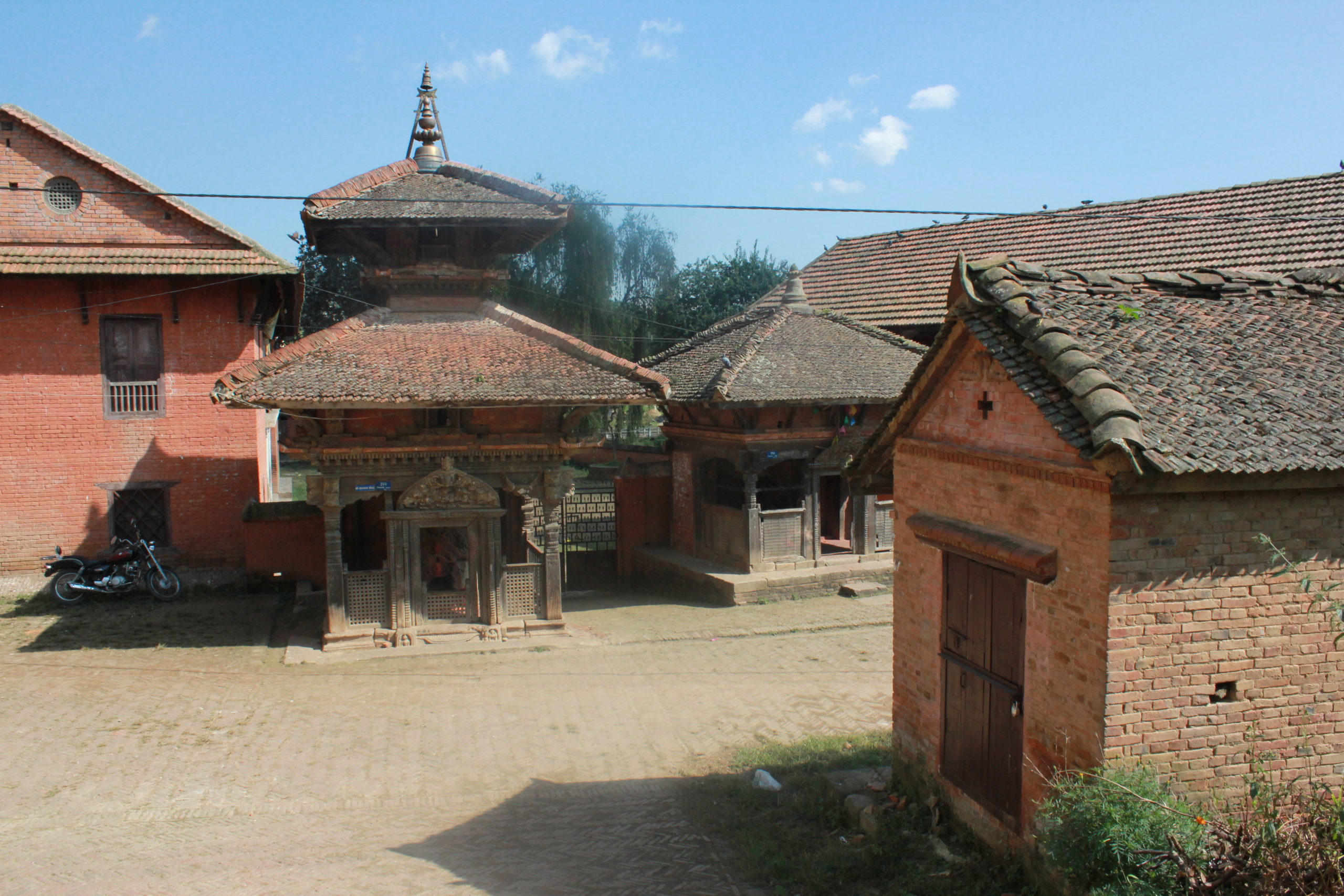
Co-existing private and religious space, a typical example of Newari town.

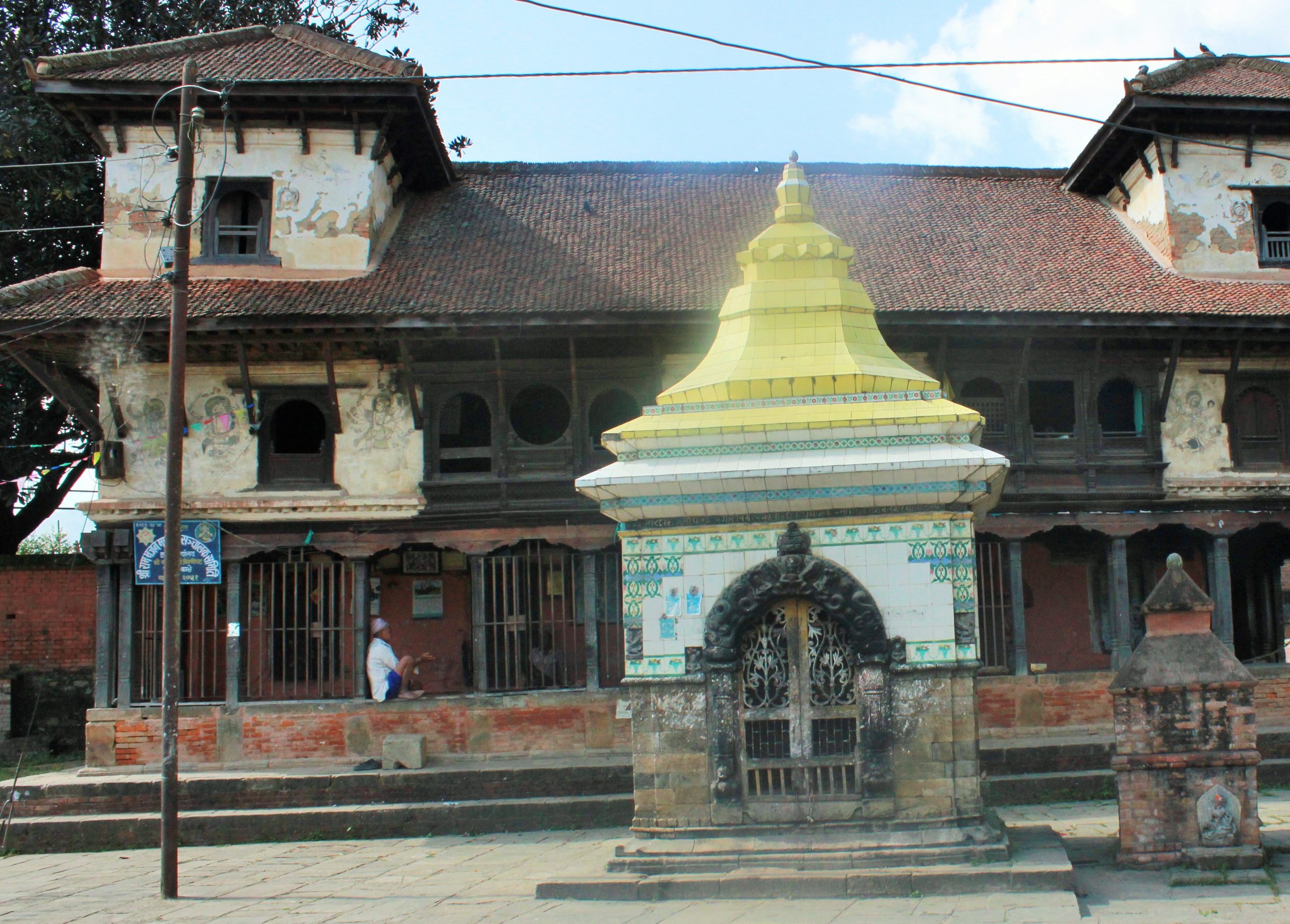
I started with the ghat (edge of a holy river which is used by devotees for taking bath and prayers as well as for cremation) on the northern part of the town. When I was there, I saw three different cremation spots separated for 3 different castes. On the other side of the river, women were washing their clothes and carpets as it had abundant water directed from Khokana. There on the square, one could witness the history with some of the oldest and unique temples. The small Ram Sita temple was claimed to be the oldest by one of the local residents. A sattal (two stories open rest house) on the west has unique paintings that tell stories of different eras of different Hindu gods. These artistic elements need serious preservation as the paintings are fading away and the building is also at a very critical stage.

Newar communities have been known for communal living with common open spaces for interaction and social functions. Due to rapid urbanisation, these activities have been lessened in these small towns. So was the case for Panauti. Basically, their major profession was agriculture but many youths nowadays have chosen other professions in the cities and hence, the vibrant open spaces during the day are almost empty with few old people drying their grains and smoking hukkas (shisha) in the house front. Amazingly there are many sattals and patis (one storey open resthouse), but mostly they are empty during the day, hopefully, they are occupied during weekends and evenings. Westernisation is the major event that is taking place in our societies and merging all cultures together. This is very important for growth and equality. But we must not forget that each culture has its own identity and uniqueness and that should not be homogenised otherwise we will not have any stories to share to our next generation like the man was doing sitting in the sattal of Ram Mandir.

Temple complex with religious paintings on the wall.

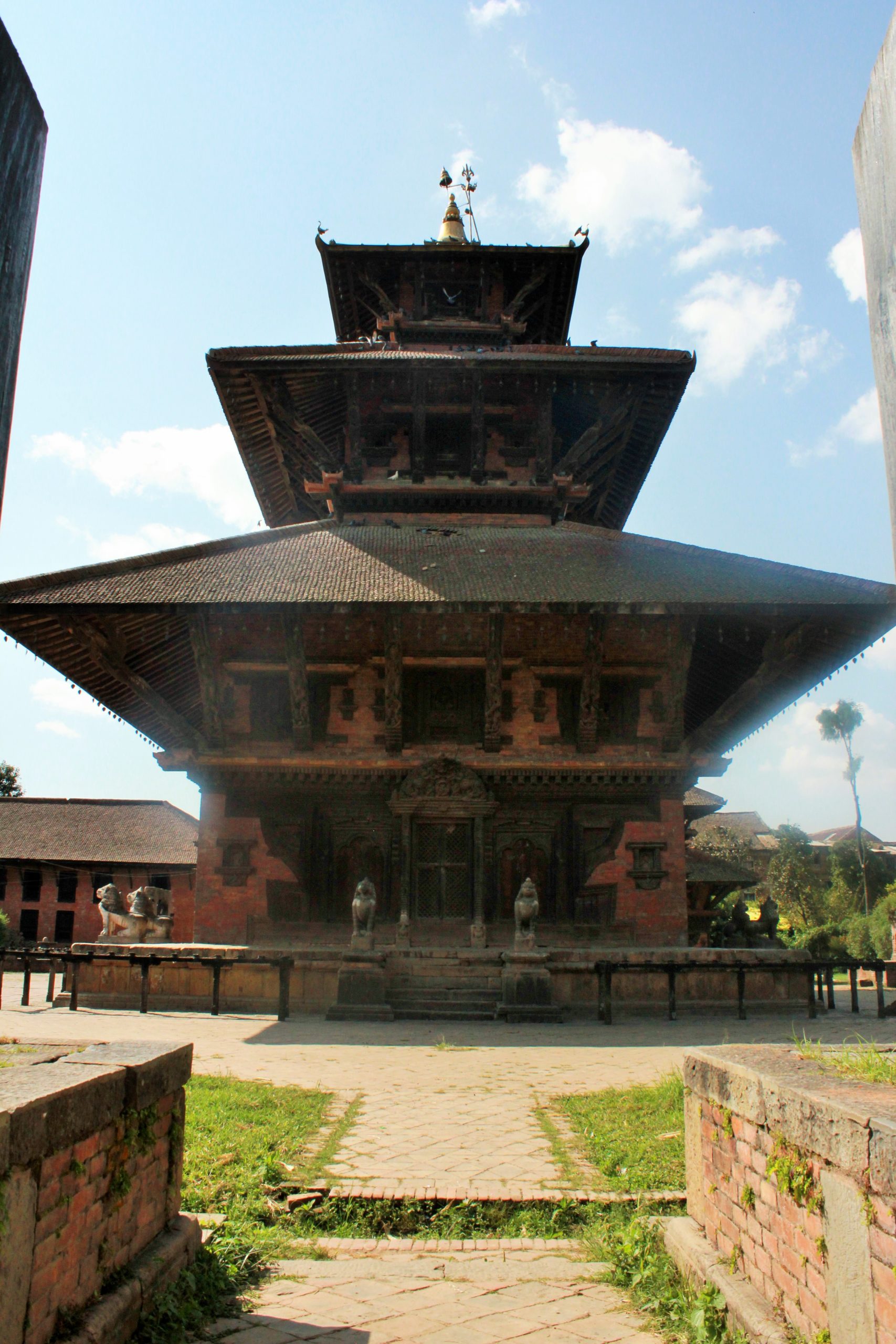
Moving towards the old entrance of the town is dominated by the big temple square which proudly houses the Indreshwar Temple. It is one of the largest pagoda style temples in Nepal, which dates back to 1294 CE. It is also the oldest surviving Newar-style temples in Nepal. When you enter the huge square through its narrow gate, you see the extravagance. To see a temple in a small town like Panauti which is taller than Nyatapola of Bhaktapur was an experience in itself. The courtyard is surrounded by other temples and a museum.

Indreshwar Temple

With many festivals, sattals and streets and courtyards, this town still reflects the vibrancy of old Newari towns. Though it’s an agricultural town, like any other Newari town, arts and artefacts present here to add more intricacy to its uniqueness. Like in any other historical towns in the Kathmandu Valley, Panauti is also at its peak for preservation. As long as the spirit is there, we can still save existence.