मसँग काठमाडौंमा ५ रोपनी जग्गा भए…..

सानो सानो टुक्रा गरेर, आनाको करोड करोडमा बेच्दिनथें, खुला मैदान बनाएर घण्टाको ५० र १०० पार्किङ शुल्क लिएर राख्दिनथें, कसैलाई सर्लक्क लिजमा दिएर, दस वर्षको भाडा उठाउँदिनथें । त्यसो भए तपाईंहरूले सोचिरहनु भएको होला, के गर्थे होला भनेर? आफैँ घर बनाएर बस्थे, ठूलो कम्पाउन्डले घेरेर? अहँ, त्यो पनि होइन।

म त ठूलो चौर बनाउँथें – नेपाली दुबोको, त्यसमा साना साना बगैँचा पनि थप्थे, रंगीबिरंगी – आफ्नै शहरको प्रजातिको बोटहरूका। अनि उफ्रने, खेल्ने, शान्तमा चराहरूको आवाज सुन्ने, भारी बिसाउने, एक छिन सुस्ताउने र प्रकृति र समाजसँग अझ नजिक भई नियाल्ने वातावरण बनाउँथें। म, एउटा आर्किटेक्ट, त्यसमा मेरो मास्टर्सको पढाइ चाहिँ ल्यान्डस्केप आर्किटेक्चर। त्यसमा पनि मेरो फोकस भन्नुपर्दा काठमाडौं र काठमाडौंजस्तै अरू शहरका लागि खुला ठाउँ व्यवस्थापनको लागि फ्रेमवर्क बनाउने। पढाइ नै त्यसै सम्बन्धी गर्न मन लाग्यो, दिनदिनै आफ्नो शहरको रूप कुरूप भैरहेको देख्दा। सानो छँदा खेलेका, दौडेका, कति धेरै सम्झनाहरू बनाएका ठाउँहरूमा आजभोलि बच्चाहरू खेल्दैनन्। त्यहाँ त केवल जग्गा सम्याउनका लागि डोजर चल्छन्, ढलान गर्नका लागि क्रसरहरू चल्छन्, एक इन्च जग्गा एता उता होला भनेर दाजुभाइहरूका तिखा तिखा शब्दहरू चल्छन्।

यस्तो पौउको भौउमा बिक्ने जग्गामा कसले खुला ठाउँ राख्ला र! अनि मैले यस्तै कुरा गर्दा सबै जनाले मलाई पागल भन्छन्। र मैले म भएको भए त यस्तै गर्थें भने भने, “तेरो छैन र त भन्छस् नि” भन्छन्। अचम्मको कुरा त के छ भने, यो तितो हुँदै गैरहेको समाज, यो एक अर्काप्रति नकारात्मक सोच, सधैं हुने इरिटेसन, यो सबै नै हामी कहाँ शहरी हरियाली नहुनु र दिनदिनै बढ्दो प्रदूषणको नतिजा हुन सक्छ। यही ठाउँमा त अनुसन्धान गरिएको छैन, तर विश्वका शहरहरूमा भएको अनुसन्धानमा यस्तो कुरा प्रमाणित भैसकेको छ।

बच्चाहरू स्वतन्त्रसँग आफ्नो घर वरिपरि आफ्नो उमेरको हिसाबले कति परसम्म जाने, यस्ता कुराहरू पनि विश्वमा अनुसन्धान भैसकेका छन्। आजकल त पन्ध्र मिनेटको शहर भनेर निकै चर्चामा पनि आएको छ। यो भनेको चाहिँ सबै दिनदिनैलाई चाहिने आवश्यक कामकाजका ठाउँहरू मात्र १५ मिनेटको दुरीमा। विश्वका शहरहरू निकै ठूला छन्, त्यहाँ हिँडेर अथवा साइकलमा धेरै टाढासम्म पुग्न सकिन्न। पहिला शहरको योजना बनाउँदा, धेरै नै ठूला सडक, गाडीमा मात्र ध्यान दिएको पाइन्छ। यस्ता ठाउँहरूमा आजकल यस्तो पन्ध्र मिनेटका शहर र बस्तीका कल्पना गर्न थालिएका छन्। तर हाम्रो काठमाडौं शहर, जुन पहिले पैदलमैत्री थियो, अहिले बाटोमा हिँड्नै नसकिने भएको छ। यति सानो, चिटिक्क परेर मिलेको शहर, मानिस र साना साना बच्चाहरूलाई मनपर्ने खालका बाटाघाटा, सानो सानो चोक र गल्लीहरू, जहाँ मानिसका भावनाहरू साटिन्छन्, कल्पनाहरू फुर्छन् र जहाँ साना साना नानीबाबु खेल्दै, लड्दै, पढ्दै रमाउँदै र धेरै कुरा सिक्दै डुल्न सक्छन्, यस्तो शहरलाई मासेर कहिले सम्म हामी पश्चिममा फेल भैसकेको अवधारणामा हाम्रो शहरी योजना बनाउने? अब पनि नसिक्ने?

ठूला ठूला अनुसन्धान संस्थाहरूले करोडौं खर्च गरेर अध्ययन गरिरहेका शहरका अवधारणा त हामीकहाँ अहिले यसै छ। त्यसलाई मासेर हामीचाहिँ उनीहरूले फालिसकेको मुकुन्डो लगाएर बस्ने? हाम्रो शहर विकासका योजना बनाउने, मन्त्रालय, स्थानीय निकाय र सबैभन्दा धेरै प्रभाव पार्न सक्ने हाम्रो शहरका प्रतिनिधि मेयरहरूलाई मेरो प्रश्न र सुझाव पनि – अन्तर्राष्ट्रिय स्तरको अनुसन्धान र अध्ययन गरौं, समाधान र विकल्पचाहिँ हाम्रो स्थानीय सन्दर्भसँग मिल्ने बनाऔं। मात्र यत्ति गरिदिए पुग्छ।

नीति ढाँचाहरू त बन्दै गर्छन्, र त्यसलाई अपनाउँदै जाने हो। तर सर्वप्रथम के गरेर शहर राम्रो बनाउने भन्दा पनि के चाहिँ गर्दै नगर्नेमा हामी ध्यान दिऔं। यसमा तपाईंहरूलाई थुप्रै किसिमका विज्ञहरूको आवश्यकता पर्छ। एक्टिभिजमले हामीलाई चेतना त दिन्छ, तर दिगो विकासका लागि विज्ञहरूको सल्लाहबाट आफ्नो कार्यहरूलाई सकारात्मक र सफल बनाउनुहोस्। सही विज्ञहरूको पहिचान गर्नुहोस्। र स्थानीय बासिन्दाहरूको कुरा सुन्न र समावेश गर्न नछुटाउनुहोस्। र सबैभन्दा महत्त्वपूर्ण, सबैभन्दा कमजोर र सीमांतकृत जनसंख्याका लागि योजना बनाउनुहोस्। बलियाबाङ्गाले त आफ्नो जोहो गरिहाल्छन्, ती निर्बलका लागि शहर बनाउनुहोस्, समावेशी हुनुहोस्। वास्तवमा उनीहरु कमजोर होइनन्, हाम्रो शहर उनीहरुको लागि असक्षम हो – सफल शहरमा सबैले आफ्नो स्थान पाउनुपर्छ।

शहरमा खुला ठाउँ र हरियालीलाई प्राथमिकता दिनुहोस्। यस्ता हरियालीका ठाउँहरूमा हाम्रा नेपाली बोटबिरुवालाई प्राथमिकता दिनुहोस्। र यस्ता ठाउँहरू बालमैत्री, बच्चाहरूसँगै मिलेर योजना बनाउनुहोस्। यस्ता खुला ठाउँहरू राम्रोसँग योजना गरेर बनाउन सकियो भने यसले हाम्रो शहरको सामाजिक र सांस्कृतिक लाभ, यहाँ बस्नेहरूको शारीरिक र मानसिक स्वास्थ्य लाभ, यहाँको वातावरणमा सुधार हुने प्रभाव साथै यहाँको आर्थिक लाभमा समेत टेवा पुर्‍याउँछ। सुनेको छु, हाम्रो शहरमा थुप्रै सार्वजनिक खुला ठाउँहरू मासिएका, मिचिएका छन्। कति रोपनी जग्गा त पत्ता पनि लागिसक्यो रे। यस्ता जग्गाहरूलाई फेरि पहिचान गरी यस्ता ठाउँहरूमा हरियाली प्रवर्द्धनका कामहरू गरौं। फेरि हाम्रा बालबालिका उफ्रिने, दौडिने, लड्ने र लडेर फेरि उठ्ने ठाउँहरू बनाऔं। यी साँचै नै आधारभूत आवश्यकताहरू हुन्। र यो गर्नुका फाइदा पनि छन् शहरी विकासका लागि। यसरी हुर्केका बालबालिकामा आफ्नो ठाउँसँगको आत्मीयताको विकास हुनेछ र आफ्नो ठाउँको हेरचाह गर्ने जिम्मेवारीको चेतना पनि। उनीहरू सधैं शहरका सबैका लागि वातावरण राम्रो बनाउन काम गर्नेछन्।

Tundikhel: Because it is not just an Open Space! – It is a legacy well earned.

Tundikhel: Because it is not just an Open Space! – It is a legacy well earned.

City Open Spaces speak history and identity of the city. They make our cities liveable, safe and welcoming for everyone. How we plan and use it matters! Maybe not for the elites and dominant groups, but it matters for the most vulnerable ones, for the marginalised population. Are we inviting them to explore these spaces or taking one more chance away from them from experiencing their city, taking one more basic right away from them? In different centuries the use and understanding of public space has changed due to the influence of cultural exchange, politics, economy and technology. And in the 21st century is this how we envision our public space? By turning it into a mere football ground? A dynamic young leader like Mr. Shah could manifest much more.

Open Spaces

A city is a dynamic fabric. Its dynamism depends on how well-planned its Open Spaces are. Strategic planning of these spaces offers numerous benefits, promoting sustainable development through cultural preservation, social inclusion, environmental, health as well as economic benefits and overall, a beautiful city.

Just adding the right type of greenery to urban open spaces significantly reduces temperature and improves air quality. The air quality index of Kathmandu looks scary. It seems there is no discrimination here, as we all breathe in the same air. Perhaps some have air purifiers at home. But then it means they cannot go outdoors in their own city, now see who is discriminated here.

Public Open Spaces work best when they establish a direct relationship between the space and the people who live and work around it. It starts with independent mobility and freedom of exploration to how you slowly develop ‘place attachment’ and feel the urge to protect it and take care of it – a mutual connection developed through a long span of time, childhood on.

To achieve urban integration means thinking of urban open spaces not as an isolated unit – but as a vital part of the urban landscape with each category having its own specific set of functions. River corridors and regional parks provide biodiversity and ecological values along with an opportunity for recreation and religious activities; a small parcel of land on a neighbourhood scale can be a playground or a place to relax; historical courtyards, streets and squares can still provide traditional functions. Open Spaces should also cater for sports facilities which could be on the outskirts with large unused lands. Likewise, City Open Spaces like Tundikhel play the role of preserving the identity of the city and providing a sense of belonging to everyone. A ‘network of open spaces’ with linkages, access and continuation is needed to strengthen them.

City Open Space – everybody’s equal access and say

As a City Open Space, people should be able to enjoy the urban experience as a venue for a range of different activities, from outdoor eating to street entertainment; from play areas to a venue for civic or political functions; and most important of all an inclusive and inviting place for walking or sitting-out. We actually have to create a ‘canvas’ where the public can do their art with their movement, we create a theatre where the public will perform their acts, we create a universe where public create their own ecosystem along with other species. As beautifully written in the book ‘Public Space’ by Carr Steven “Public Space is the stage upon which the drama of communal life unfolds.” This unfolding creates numerous images of the city as perceived by the individuals, which helps them bond to their city with its identity, as Kevin Lynch explains in his book ‘Image of the City’.

Khula Manch (Tundikhel) is this stage for us, we need it to be the salad bowl where the mixture of different cultures can find their individual expression instead of being a melting pot. The very concept of a democratic society till the twentieth century as a melting pot which mixes all the cultures together and homogenises into the one expression of national culture does not fit in today’s world. It has been mostly replaced by the pluralist approach which embraces diversity in needs, attitudes and expression rather than expecting conformity.

Another example is the Newroad. It is an open space which comes in the category of ‘Streets and squares’, which thus should be planned and managed likewise. Though I completely support that the city cores should be pedestrianised or atleast should be made pedestrian-friendly, but doing any intervention without a democratic process will pay back harshly. Streets in the city core are much more than just open spaces with functional linkage. They speak history, they have witnessed different eras and transitions, started a completely new revolution, or continued a legacy for generations. These infinite layers of social, cultural and political events have been well encrypted in Newroad too. Studying in detail, unfolding each layer delicately, identifying the sensitive aspects, healing the bruises and carrying forward the regenerational elements is just taking one right step towards its revitalisation. And this cannot be done without proper process and methods, a team of well-versed experts who value the local knowledge should start the process using innovative methodologies and in collaboration with the local people and stakeholders. The team should not go with a solution but start working together with the local community to find the issues in the first place and then work together to find solutions. In case of Newroad, there should have been a research and study team just to understand the core of new road and develop a framework for its redevelopment, then an open design competition following these guidelines should have been made, several rounds of presentation of the design to the local people and wider public, feedbacks must have been taken, a team to evaluate all these must have been formed, I can go on, I hope the gist is understood here.

Open spaces are where democracy is worked out literally on the ground. Many voices have been raised, many rulers have been challenged and revolution has taken its toll. It’s only a matter of time before the voices get louder, sooner or later, everybody wants to live in a society where they feel their voices matter. If a city fails to cater for this, they show their rebellion either by leaving the system (youth go abroad), expressing negative gestures (teenagers leave graffiti on the walls) or sometimes simply by littering. This liberation is rooted deep down in humanity, oppressors lose their glory in a blink of an eye. True leaders must be able to serve. As long as collaboration exists, we can envision a just society where our open spaces are ours one more time because we thrive together – a genuine participatory approach must be considered.

Creating the Canvas

If we want our city to thrive, we must study it, make plans for it and then act upon it – not once but in a continuous cycle. While studying let’s be open, let’s be systematic, let’s be inclusive, let’s find categories, let’s identify core strengths and problems, let’s do critical reflection and find methods to find solutions, let’s collaborate and then work together for solutions. And let’s apply these solutions taking all measurable and immeasurable impacts. And after taking these actions, let’s reflect upon our processes and adapt and improvise, be flexible and democratic, let’s transform and educate ourselves to comprehend the next phase of studying, planning and then taking action. We must keep on working, but in each new action we are a little more aware, a little more equipped and a lot merrier. This is how a city works, amongst the chaos, amongst the unanswered – question everyone and hear their answers.

And when it comes to planning city open spaces, a thorough understanding of the community’s needs, preservation considerations, and a commitment to sustainable and inclusive intervention is a must. Engaging with the community and relevant experts will be key to making an informed decision that respects both the historical context and the contemporary needs of the area. This would help the city move towards the right direction, not reach the destination as off, but just start on the right path.

What’s going wrONg

I do believe instead of trying to prove that one can make a difference or can bring about the (visible) change, a leader should focus on forming a system, and institutionalising correct order. “If you are not here to prove anything to anyone but to really make Kathmandu sustainable and developed, believe me, you would take this approach.”

As the mayor himself says reconstruction of Dharahara is a ‘white tower’. So how are we reconstructing the image of our intangible heritage is the question we need to raise together! “An open space where you could play football too” or “a football ground where you could do other things too”. The image of an open space is not merely physical but shaped by diverse activities occurring at various times. It is more than a piece of land; it embodies the heritage of activities from the past to contemporary society. As old residents lose their identity and new ones struggle to find one, we must contemplate if this is the path to societal development.

People who play football will find a way to play football anywhere. But people who are reluctant to explore these open spaces will be even more constrained. We must design and manage cities for this population. Then we can talk about inclusion, equal rights and opportunities. People from every field and every walk of life must understand this. If we design cities for cars we will get cars, if we design cities for people, we will get people. But if we design and make them accessible only for certain groups of people, we can bid goodbye to the philosophy of our federal democratic republic nation.

What should be done

So how do we design and plan our spaces so that it works for all? Where children can run around free and wild, elderlies find their chitchat spot not so far away from the children’s laughter, a young girl finds solace under a tree or a visually impaired boy smells and feels a fresh breeze of air? We do not tap into our expertise, we do not tap into our authority, but as Amanda Burden has said, we tap into HUMANITY!  She was appointed by the city commission to improve the quality of life of the people in New York City. With her humble approach she was not making plans for the big apple sitting at her desk, she went out walked every street and corner, identified the needs of the city and its people, and then was able to create landscapes that literally worked for all, supporting diversity and biodiversity. One such example is the ‘Highline’ which was an abandoned railroad. Rather than demolishing it rehabilitating was a great approach.

How can the process start

Kathmandu Metropolitan City (KMC) should start by identifying the different types of open spaces and then develop a framework, assigning different functions and features to each category. These should be provided to the communities who can then use them to develop their open spaces using these guidelines, along with monitoring and maintenance. But again, when it comes to open spaces like Tundikhel and Newroad, KMC has to take an innovative, sensitive and contemporary approach, to plan and manage it, taking diverse perspectives, approaches and expertise, and not forgetting communities are the most important experts. So, to create a sustainable, inclusive, equitable city, we must work in that direction, as is mentioned in my favourite quote from a very famous urbanist/author/activist.

‘Cities have the capability of providing something for everybody, only because, and only when, they are created by everybody.’ – Jane Jacobs.

Are we ready as experts, as authorities, as people in the position to play our roles to provide the citizens, especially children, their rights to live in a healthy and thriving city and, in the process also make them responsible? Or do we want to create more constraints and thus make our society ever more ill and disintegrated? Our open spaces have been resilient throughout centuries but they are struggling to survive, it’s time to make them lively again so that our lives are also enriched. Do we want to create a win-win in this scenario or do we want to lose as a society?

To thrive, Kathmandu Metropolitan City must embrace collaboration and actively listen to the diverse voices within its community. Let’s start a green revolution, an Open Space movement!

We need to rethink our notion of ‘Who plans and shapes our cities?’

One can simply say ‘planners, designers, architects are responsible to make a city liveable’, but there is an overarching theory to it, – ‘who has the finances, who sponsors the projects, who have vested interest and power’ are the ones who build the cities. Most of the projects being funded by the government take a big political influence.

Being an architect myself and with expertise in open space planning, I have bagged many projects through multiple links and experiences as an architect. But when it comes to landscape planning and public space designs, my expertise is not valued as much as the local representative’s interests. The private projects related to construction are more resource-dominated. An architect’s knowledge is dominated hugely by vested interests, majorly political, financial as well as lack of respect for the profession, the cities are massively impacted. Especially when it comes to open space planning, we have to take a different approach altogether. There is no perfect design but we should let the space develop as the people start using it, we allow freedom and expression. We should not tap into our expertise but we should tap into humanity as Amanda Burden, an American urban planner said. This does not mean we do not do anything, we actually have to create the canvas where the public can do their art with their movement, we create a theatre where the public will perform their acts, we create a universe where public create their own ecosystem along with other species. There is no institution here in Nepal, which prepares such experts and the ones who have studied abroad and come back to give their knowledge and learning to their community are not welcomed. This makes experts like us sad and frustrated because we can see that what is happening in the city is not right and it will have a long-term impact to all of us but we are not in the position to change it and nobody is ready to listen.

The discussion put forth is in itself controversial because in Asian cities, particularly in Kathmandu, I have seen the professionals who are supposed to shape and plan the cities – planners, architects, construction managers and conservationists not being able to use their expertise but more playing the roles of activists when the authorities are not able to make good plans and proper management policies for the city. These government authorities do not consult and hire the experts but they rely on their resources who come to work in government jobs through a common IQ-based entry examination. The module of exams is outdated and those who pass these examinations come through tough competition of not argumentation and creativity but more of the banking system of education. I believe these government officers should play the role of managers and let external experts do the technical jobs. But as soon as they are in a position to make decisions, they want to implement their own ideas without much research and planning. Even when they hire experts, they try to impose their own understanding and solutions. Most of the time, its not even a lack of expertise, it’s the lack of a good mindset. This lag in the system is making the city pay a huge price when it comes to sustainable development and regenerative green spaces. I have worked both as an architect as well as a community planner. I have experienced there is no democratic decision-making and planning approach when it comes to planning open spaces. People, especially children lose connection to their environment, both natural and social, and are deprived of their basic needs. We need to expose them to their environment so that they explore and reach their potential with social, physical, and psychological development and later become responsible citizens. When this happens they understand the need of the city and use their skills and knowledge to make it better, that too, with collaborative approach.

So how do we pierce through the bureaucrats as well as elected members in the local community? After I completed my master’s I came back to Nepal to share my knowledge and implement it through various agencies. Initially, I tried to go to the local areas with solutions and it did not work. As an expert, I could not convince them with my strategies. Then I worked out a way to work together with them but the adults who are in the position to implement the plans were not ready to accept my ideas, they were not even ready to work together. Then I took the approach of working with children. This approach has been widely used in many cities of the world now. The contemporary urban planners and researchers in children spaces and development both believe that children can act as catalyst for urban innovation. Their views are more diverse and they can bring solutions to their communities if they can have meaningful participation. Hence, I also used it contextually in different neighbourhoods of Kathmandu, successfully.

Though this has been realised in urban planning community globally, how to do this was not the issue raised by many contemporary researchers. I, therefore, moved towards the solutions, not by proposing the solution but by taking the actual steps which could lead to the solutions involving the main stakeholders.

As a researcher hence I tried to find a balance between research and action. I went into the community, especially to the vulnerable groups, in this context the urban middle-class children and worked with them, co-researched with them to find out the actual situation of community spaces and how they are shaped and how the issues can be solved. I conducted participatory action research with the children in different communities in Kathmandu to find out the situation of their environment through their lenses and also to propose a solution for the same. Participatory action research is an approach which believes in critical pedagogy which means giving voice to the ones who are oppressed, which is in line with the concept of Paulo Freire who believed that education must aid in developing critical consciousness and the learners or the participants must act to liberate themselves and the society also from the injustice, their engagement is crucial for this.

I believe that this type of grassroots intervention can actually bring forth solutions to the existing problems, as people who are actually living in such situations will be able to identify the genuine problem and in turn, propose solutions for the same, and in the process, empower themselves. If we continue such efforts, we can really bring about a change in the community, then in the city and in the country as a whole. But the process should be continuous as well as there should be a genuine concern for the well-being of the community through planned neighbourhoods and action-oriented interventions. I say this always and each time, that the people are not supposed to be fed, they are to be taught to grow and prepare their own meals.

As the city is a dynamic built, anyone who wants a city to thrive, must study it, make plans for it and then act upon it – not once but in a continuous cycle. There must be support from the government and local bodies for these types of interventions and research.

Coming back to the topic of this article ‘who plans and shapes the cities?’

I would like to add my favourite quote from a very famous urbanist/author/activist whose theories and observations are the holy book for architects and urban planners –

‘Cities have the capability of providing something for everybody, only because, and only when, they are created by everybody.’ – Jane Jacobs

Are we ready as experts, as authorities, as people in the position to play our roles to give the citizens especially children, their rights to a healthy and thriving city, in the process also make them responsible? or do we want to create more constraints and thus make our society ever more ill? Do we want to make a win-win in the battle or do we want to lose our society?

It’s Time for Communities to thrive!

‘If there was a big green space in my neighbourhood, if I had a place to go during this pandemic, I would quietly go there and sit. I would sit for hours and contemplate. I would lay down in the grass and hear the birds sing. I could stay alone because the nature would give me company. I could walk my dog in those lanes where there is enough space for all of us. Those big buildings and no open spaces in the city have confined us all inside these concrete walls. An overcrowded city is always vulnerable. This is more relevant now that this pandemic requires more space per person for everybody to be safe. During the 2015 earthquake, the situation was different. People came out and stayed together and faced the disaster together. Everybody wanted to be with one another because that gave them hope and relief. In this case, this is not possible because, social distancing is the main criteria for safety. I cannot not even imagine if both of these crises came together. How could we have even managed to cope with it.’

I have always been the type of person who thinks communities have the capability to strengthen, transform and be self-reliant in all aspects of life. Communities when work together can bring about giant leap in their existing condition. Should we always follow the global trend and mould our lives into identical identities or should be also shape our individuality?

This is a perfect time to reminiscence on evolution and life. The basic concept of food, shelter and clothing has been transformed to a level that this asset has been taken for granted. The online world has a huge role to play in this. Making technology available to use for the cause that are not for a progressive future is making our society fake day by day. Before when we did something we never thought if people are seeing us or if people are taking about my daily life. Now with the use of social media, people know about your daily life.

I see in social media, people flaunting their houses with large open spaces. They say that they have taken all the safety measures to stop the virus from entering their houses and closed their gates so that nobody can come close. This is a good practice. Of course, the idea is social distancing, no way anyone could invite over guests to their houses in such a crisis. But do they even consider letting a homeless enter their compound and at least shelter in the huge open ground they have. That is why public open spaces are even more vital at this moment. Those who have a lot of private land are closing everything and taking advantage of the privilege they have. Don’t flaunt your privilege in social media. Try to be compassionate and try to see the misery around you.

But there are these huge groups of people who have been selflessly contributing during the time of crisis to serve the most needy in the community. Community groups, youth groups who are involved in crises, feeding the poor, cooking and sharing, they could also contribute to the development of open spaces. As vital as food and shelter, mental well-being is important for a healthy life as recommended by WHO. For such wellbeing one needs fresh air, exercise, green areas and many such facilities that can only be provided in open spaces. At times like these and always open spaces are as important for the public. Open spaces in these contexts are not big open areas but small spaces in between the communities, where people can jog at a safe distance and smile and greet each other, where people can get some fresh air, where they can create these bonding which are vital for a healthy living. Maintaining social distance as a social being is not an easy task for us but we should try to bring solutions that can maintain our safety, at the same time, bring us together as community. We could share stories by writing on walls, we could leave messages, we could do the same activities at the same time but in our own house or in the terrace, there are many we could do to stay connected and motivated. This will surely bring the missing bond among the communities.

Maybe we can share our skills and help each other in need. May be someone is good at cooking and the other is good at plumbing, may be someone can take care of the garden we have made in the community open space. Someone could make their artwork and display in the open spaces. And someone could make some play areas and children could play in turn after properly sanitizing, may be someone who plays music could give concerts from their terrace and everybody can have a party from their home. Could we do all this? How could we do all this?

The neighbours were always together, but we were so busy that we never thought spending some time with them is important. But between those quick smiles, passing by in cars, seeing the light turned on in their rooms, seeing them walk their dogs, we always shared a special bond that only the place where we live in can provide. Let’s make these places and memories ours by appreciating and creating more opportunities for such encounters and interactions.

We will thrive and we will rise again. Let’s play our roles and contribute.

Childhood – different perspectives

A normal weekday, two siblings, didi (sister) and bhai (brother), walk hand in hand amidst the crowded, chaotic and somewhat self-centred bunch of denizens. Didi probably around 7-8 years old, bhai seemed a couple of years younger. It was around 8 am and as the crowd of urban area would behave, there was a certain rush in the environment. People all dressed up for work, rushing bikes, kids in uniform and school bags, some opening their shops for business, some fetching water from the stone spouts. Older females with plates (thali) filled with offerings to deities were heading towards the temples. Some young folks in uniforms were drinking tea and complaining about the mundane. Some older lads were also in the corner shop drinking tea, reading newspapers and complaining about the country and the whole system. To my surprise, a lot of tourists with fancy cameras already in action to create memories, some to remember the place, some perhaps to remind themselves how lucky they are not to be living here. There was more your eyes could witness, there were many stories you could hear and tell. But today I want to focus on my didi and bhai couple. Amongst the ruins of temples and houses, yet to be constructed after the 2015 earthquake, patis and shattals (rest houses) with unrestful people, sound of prayer bells and vehicle horns, the white neoclassical palace also under reconstruction, lots of eateries, shops and bargains, there still seemed to exist a time that was still. It seemed that the rush each civilian beared had nothing to do with the calmness and existence of the Basantapur Durbar Square and yet they maintained a sense of harmony. Just like the two little soldiers who found their way into this flamboyant yet modest scenario.

Public space is the stage upon which the drama of a communal life unfolds.” The book Public Space. (Carr, 1992). https://www.amazon.de/Public-Space-Environment-Behavior-Stephen/dp/0521351480.

This dynamic space I believe has to remain calm on itself, as the stage remains the same, only the plays change.

Ragged loose trousers, a black polka dotted pink top, a bit shorter pale outer with orange collar and linings, a fancy colorful bag and a pair of blue ballerina shoes, didi sure looked she could carry any style with ease. Bhai was a bit arrogant in his outlook wearing a tshirt written ‘It’s all about me!’. Of course to add to the swag didi was carrying an umbrella, black in color and a little crooked.

Look! A mouse!

When I saw them the first time, they were amused looking at the ground. They were near a stone spout in one of the squares of Basantapur in Maru tole. Their journey started from there where I followed them, not stalked! What were they amused of? A small mouse! Didi had her umbrella opened though it was not raining. Didi was excited but not as much as bhai. He wanted to observe the mouse, why it was moving, why it was so small, what was it? perhaps he had a tons of questions in his mind but as a researcher with children I could recognise the curiosity in his eyes. The drive that makes you want to learn naturally without anyone forcing you to do so in a closed room, is the best teacher you could ever have. He was so engaged that didi had to hold his hand and take him away from there as if they were trying to reach somewhere and she was in a rush.

Holding hands they moved forward towards the Maru Ganesh through the narrow passage. To add to its narrowness, on both sides, there were bricks to construct new houses and ruins of old traditional houses. On the right side was the reconstruction site of Kasthamandap, which also collapsed during the 2015 earthquake. It is under reconstruction now using the traditional methods. Now didi closes her umbrella which is apparently not so easy to do. While she tries to get hold of that, bhai grasps the side of his sister’s tshirt as both her hands were busy. They meet a friend there, just exchange smiles and a bit of conversation and continue along their own path. The pulling of the tshirt was a signal that bhai was tired. The metals from the closed umbrella were dancing as the strings had come off. With that on one hand, didi carried her bhai at the back. Then they continued for a while.

Wait, let me close it first.
Crooked bond.

Along the way, they came across ground floor grocery shops, shops to buy prayer materials, street vendors who had shops literally on the path they were walking. They were selling local produce like saag (mustard leaves, spinach), spices, fruits and many things. When they were near one of the vendors place, bhai came down from his sister’s back and stopped there. Without a word, the vendor gave him one of the fruits he was selling, he took it and walked along eating it. There was no exchange of words, just the gesture. Looked like this happens everyday. How can you define this human relationship. This is so special. Then they continued and reached the Maru Ganesh. Outside there were devotees with plates full of offerings for the Ganesha. There both didi and bhai got some prasad (sweets offered to God). They also put tika (red colored blessings) on their forehead by themselves. Bhai had some sweets in his mouth, a handful in his pocket. Now they had to cross more ruins, more construction sites with bricks laying all over, wooden planks everywhere.

They are now already at the centre where all the area is paved with stone. It looks like a pedestrian prioritised area but practically it was full of vehicles. Of course they were not going very fast as there was no space and also pedestrians would be given more preference in such areas, but their noise and disturbance was felt. Among the vehicles were school vans, motorbikes, four wheel drives, taxis on standby and rickshaws. From this durbar (palace) square we were moving towards the Swetabhairava and reached the square with Pratap Malla’s statue. This square is always so interesting because of the pigeons. There are always a lot of pigeons on the ground, on top of the temple roofs and everywhere. People feed them and chase them and take a lot of photos with them. Apparently my didi was not so much impressed by this. Bhai went inside the pigeon gang and started playing as everyone else was doing. Didi just waited for him.

Bhai I think was around 4 years old. Didi may be around 7-8. It took me by surprise how bhai was interested in everything and didi was not much impressed by anything. She was more taking care of her bhai than enjoying her moments. May be she has done all that and she doesn’t enjoy it anymore, or she is more into taking care of her brother because she was asked to do so by her parents. It could be anything. But I wished she also enjoyed this moment, she also chased the birds once in a while, she also did the same as a kid of her age would do. But she just stood there waiting for her brother to come back so that they could continue their journey. Perhaps she was just being the responsible older sister. Perhaps she enjoys her time when she is free with her friends. After that they crossed the Taleju mandir (temple) and headed towards Makhan tole and disappeared from my sight.

There she goes.

Leaning towards the railings of her balcony, looking across the street view of a house inside a housing complex (a gated community), she could view many other houses same as hers and no one on the street. A car passed once in a while, while she yearned for some excitement. The housing complex was situated on the periphery of the valley, away from the chaos of the city life, well above the valley overlooking the haphazard city. You could view mountain range from here. Built to give almost a traditional look with dachi appa (Newari traditional bricks), the houses seemed to be in harmony with each other. But they lacked the basic concept of Newari architecture, the courtyards and the squares where the communal activities would take place, where children could play together while elderly could pray and share their stories. Also the streets those created opportunities for human interaction were used merely for cars. Perhaps for an eight years old girl, it was the best any parents could give in terms of physical comfort. Her toys inside her house in her playroom were waiting for her to come back. She also had a small private garden in her front yard but no one to play with. She just stays there looking, perhaps waiting for something to happen. Waiting for some stories to be made, so that she could too tell her grandchildren about all the adventures she had when she was a kid. But her life is made too perfect for that.

Panauti and its Existing Heritage

There is something about the air in Panauti that makes you calmer, makes you want to sit by the edge of the river near the temple and lets you breathe in the fresh air that you almost miss every second in Kathmandu. I went there just recently and it is a pity that I missed this experience until this stage of my life. I went there, sat by the river, walked on the temple square and listened to the old man who spoke continuously about his old tales. He did not care if anyone listened to him or not, he himself found his stories interesting. So did I.

One Saturday morning and we decided to head towards the south-east of Kathmandu, roughly 36 km. it took us 1 hour and 15 minutes to reach there in our private motorbike. The last 30 minutes was a bumpy ride due to road construction but it is temporary. If you wish to get a public vehicle you can see this link.

Religiously this place has a great value. One of the old residents of the community (Machhenarayan Shrestha) explained that there are more temples here than in Kashi of India so it makes this place religiously important but according to ancient myths if one cannot see mountain (Kailash) view from the holy place it has lesser value. The northern hills which block the view of the mountains still provide the panoramic view towards the town and it also contains herbaceous trees.

One more religiously important factor is the merging of three rivers (Triveni). This is considered to be most auspicious for a pilgrimage. Though one can see two rivers very easily, the third one is hidden. According to myth, Lord Shiva made Ganga flow through this place invisibly so that it became sacred.

Panauti is predominantly a Newari town like most of the towns around Kathmandu and it also celebrates festivals every year like those of Kathmandu with some more unique ones like Panauti Jatra. The chariots of gods and goddesses are taken around the town through the defined alleys. This is one of the most interesting parts of Newari festivals (Jatra). The veins of the street played a major role in defining the town’s form and circulation pattern. These routes and their axes are still identifiable today. The smaller veins lead one towards the bigger street and courtyards and finally towards the central or main open space dominated mostly by temples and palaces, in case of Panauti, by temples.

Co-existing private and religious space, a typical example of Newari town.

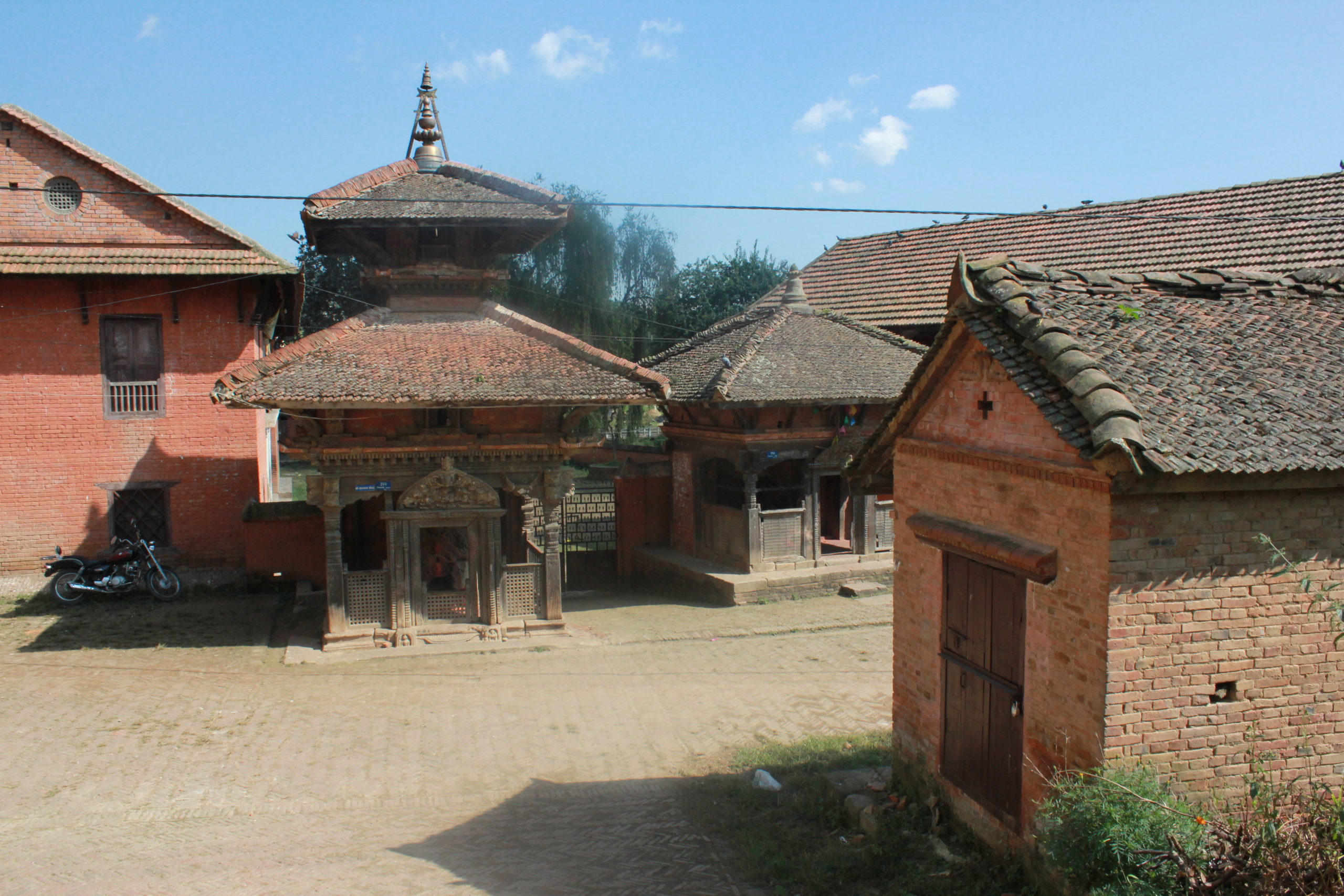
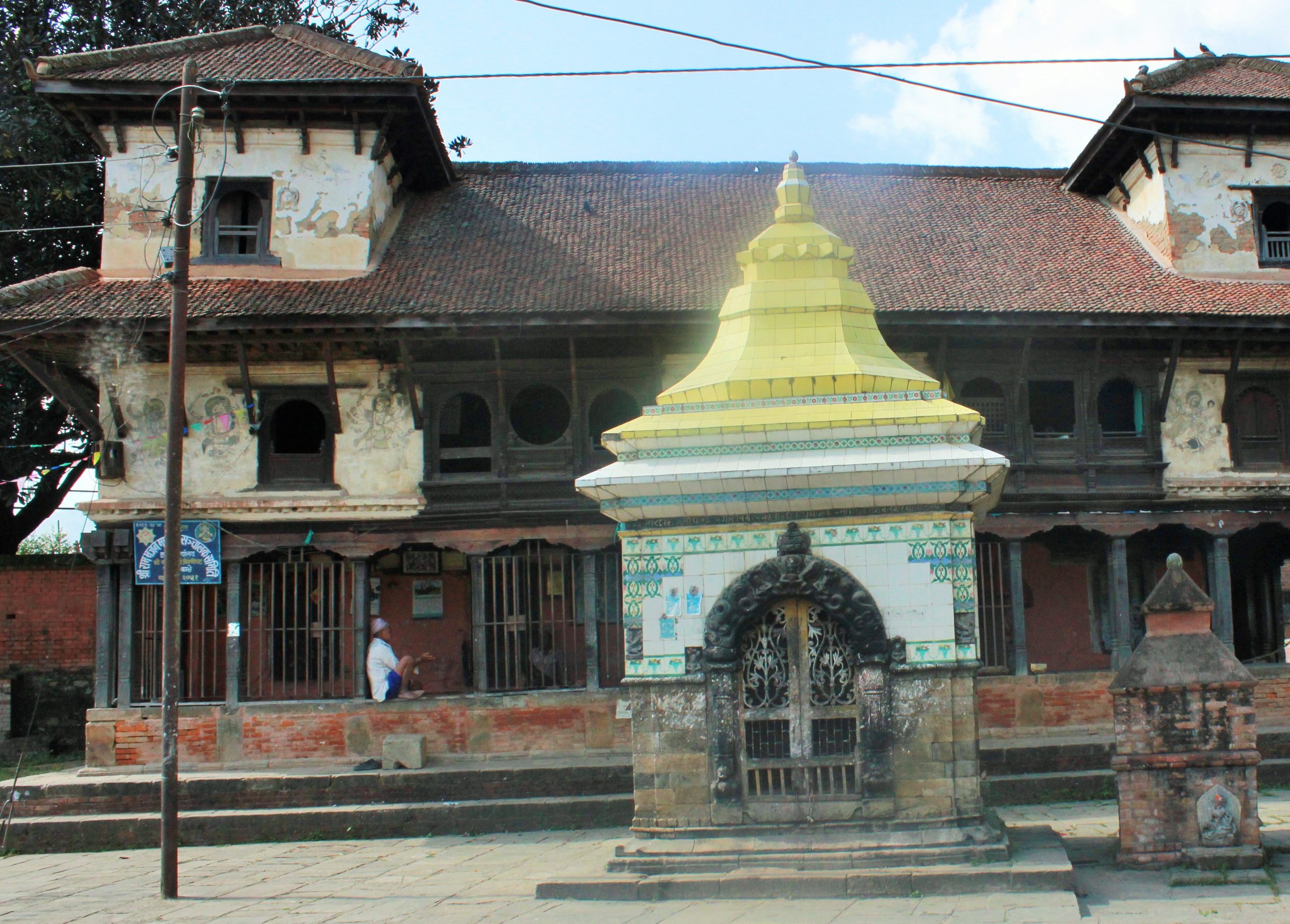
I started with the ghat (edge of a holy river which is used by devotees for taking bath and prayers as well as for cremation) on the northern part of the town. When I was there, I saw three different cremation spots separated for 3 different castes. On the other side of the river, women were washing their clothes and carpets as it had abundant water directed from Khokana. There on the square, one could witness the history with some of the oldest and unique temples. The small Ram Sita temple was claimed to be the oldest by one of the local residents. A sattal (two stories open rest house) on the west has unique paintings that tell stories of different eras of different Hindu gods. These artistic elements need serious preservation as the paintings are fading away and the building is also at a very critical stage.

Newar communities have been known for communal living with common open spaces for interaction and social functions. Due to rapid urbanisation, these activities have been lessened in these small towns. So was the case for Panauti. Basically, their major profession was agriculture but many youths nowadays have chosen other professions in the cities and hence, the vibrant open spaces during the day are almost empty with few old people drying their grains and smoking hukkas (shisha) in the house front. Amazingly there are many sattals and patis (one storey open resthouse), but mostly they are empty during the day, hopefully, they are occupied during weekends and evenings. Westernisation is the major event that is taking place in our societies and merging all cultures together. This is very important for growth and equality. But we must not forget that each culture has its own identity and uniqueness and that should not be homogenised otherwise we will not have any stories to share to our next generation like the man was doing sitting in the sattal of Ram Mandir.

Temple complex with religious paintings on the wall.

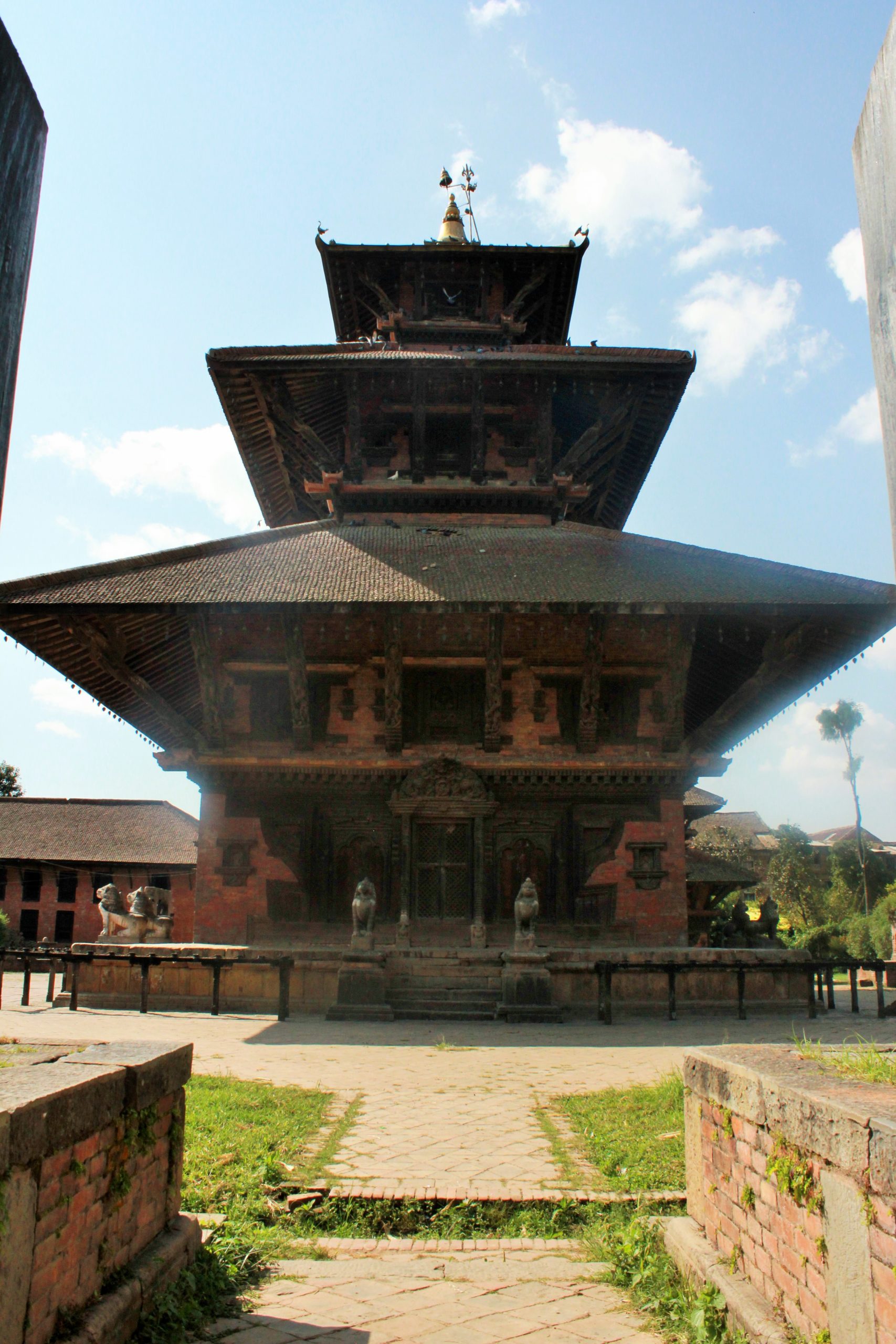
Moving towards the old entrance of the town is dominated by the big temple square which proudly houses the Indreshwar Temple. It is one of the largest pagoda style temples in Nepal, which dates back to 1294 CE. It is also the oldest surviving Newar-style temples in Nepal. When you enter the huge square through its narrow gate, you see the extravagance. To see a temple in a small town like Panauti which is taller than Nyatapola of Bhaktapur was an experience in itself. The courtyard is surrounded by other temples and a museum.

Indreshwar Temple

With many festivals, sattals and streets and courtyards, this town still reflects the vibrancy of old Newari towns. Though it’s an agricultural town, like any other Newari town, arts and artefacts present here to add more intricacy to its uniqueness. Like in any other historical towns in the Kathmandu Valley, Panauti is also at its peak for preservation. As long as the spirit is there, we can still save existence.

Labim Mall – A Modern Addition to Patan

The intricate details in the buildings with its form and the materials always excites me as an architect. I must say the new addition to the LABIM complex is far more than exciting. It is a beautiful building with well thought material and colour use. It is a good design with the playfulness of forms with multiple entrances, alleys for seating outside and the balance of indoor and outdoor. The only thing that hit me was the insufficiency of greenery. One example would be: If real trees were planted in the alleys, the dwellers would get the natural fresh air from them, instead of the ‘metal trees’ that are being planted at the moment.

Boundary, Chaos and the Standing Strong – Ashoka Stupa

Simplicity has great value. I feel comfortable going to places which do not stand out but lets you blend in with them at your own comfort. One such place in my city Patan, also known as Lalitpur is Pulchowk Stupa. It is one of the four Ashoka Stupas of Patan (oldest city in Kathmandu Valley), which marked the ancient boundaries of the city. At the time these Stupas were built in Patan (250 BC), the city was flourishing with Buddhism. Today still, we can see a unique blend of Hinduism and Buddhism in this city which cannot be experienced elsewhere in the world.

At one time, this Stupa was marking the boundary of Patan. Today it stands along the confused infrastructure of streets and buildings, dominated yet screening its own existence.

I pass through it many times, uncountable. It is on my way to work, my way to my relative’s house and many other locations. But yesterday I went there as a visitor and not a passer-by. I went there to see and look around just as I do when I go to other cities as tourists. Here began my architecture journey again to share with you. From the border of Kathmandu and Lalitpur, after crossing the Bagmati bridge of Thapathali, this place is at walking distance, you just have to keep on walking the main street but one can easily find public transport if you cannot walk around 15 minutes from Kopundole, the border of Kathmandu and Lalitpur.

Always visit a city as a residence, not as a tourist. Then only you can tell if it is an interesting city or not. I discovered this when I went to Sarajevo in Bosnia and Herzegovina for two weeks this year in March. The city looked nice and promising at the start. But when I visited each new place and explored its history for the many days I stayed there, I was mesmerized by its beauty. So, whenever you go to visit a city, try to explore it a little more than just seeing the monuments and tasting the speciality of that place. You will witness a whole new perspective.

The form of stupa gives a passer-by a feeling of contentment. The very form of Stupa symbolizes five elements earth, water, fire, wind and space, which is represented by its cubic base, dome-shaped mound, triangular conus, calyx and the top flame respectively. But unlike the big Stupas of Kathmandu valley namely Bouddhanath and Swayambhu (which are also in UNESCO world heritage), this small mound of earth covered with bricks and then overgrown grass does not give a feeling of extravagance. When you look at it from far, it is almost surrounded by buildings taller than it and overhead bridge. On its diagonal is a newly constructed modern building complex and opposite to it towards the street is municipality office of Lalitpur. These structures though functional and logical in their own space somehow make the physical form of Stupa not so dominant. But what is it that makes this structure stand out?

1

The first answer to it would be the religious belief of the worshipers and devotees. This brings positive energy to the people passing by it. As I approached its few steps at the entrance for circumambulation of the dome, I realised the inner peacefulness. In spite of the disturbance from the street, surrounding houses and parking spaces around it, once you step on its premises, it lets you enjoy its simplicity and when you look at it from bottom up, you see the five elements in its form taking you to the stage of the void. Looking at it from very close from bottom up shows the form of the dome to be converging and taking one to the stage of void through the central point where the dome converges into the conical conus and then to the nothingness and void which touches the sky. The prayer wheels which you rotate as you make a round around the dome are a precious delight. There is also a place to light candle below it all around which is normally lit in the evening. The combination of these two elements, the bells and the light standing below it gives an intricate detail to the form of a dome. And to my surprise, all the dominating structure around it did not exist and were out of view once I was inside its narrow alley to pass around it. Trees also made a huge impact in making it separate from the surroundings blocking the view of the cityscape. The beautiful sight was few children playing around the corner in the small streets near the stupa making the place livelier.

This beauty I visited yesterday, was in its full-fledged form as the air around it was also clean due less vehicle movement because of a strike. The sky appeared bluer giving its form more shape. This is one of the very few open spaces we have in our city. It is providing some space for its dwellers to breathe, to feel peace and to feel proud of the long history it carries with it. I used to come here more often when I had time. I am so happy that I decided to go there yesterday, it made me realise what I was missing, a feeling of peacefulness and bliss. More such places in your neighbourhood give you more opportunity to socialise and understand the city’s culture and activities.

Explore the areas in your neighbourhood and share with me. Try to find out about its history and today’s ambience. I am sure you will find more aspects to cover the reasons for existence.